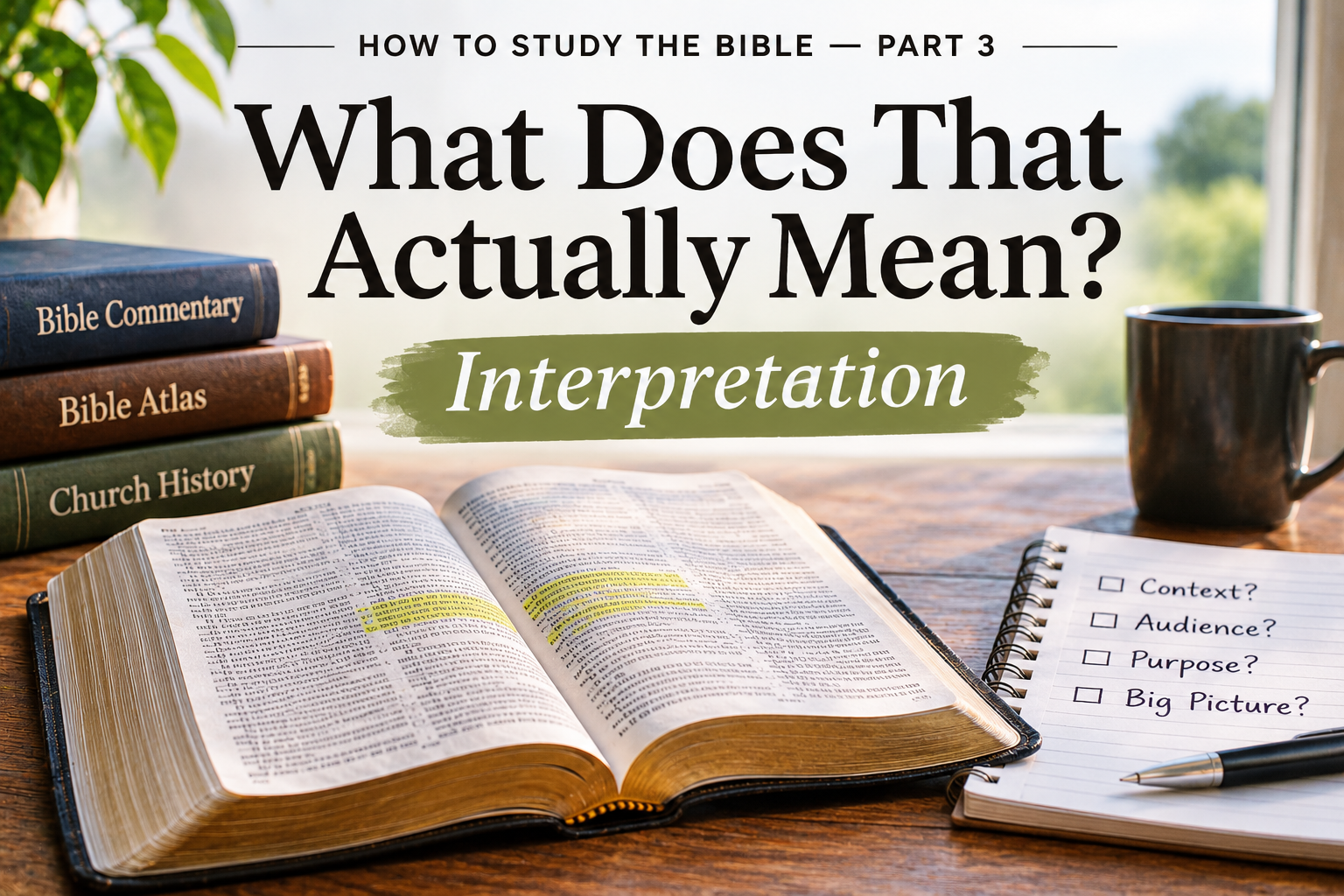
How to Study the Bible — Part 3
What Does That Actually Mean? Interpretation
In the first two parts of this series, we introduced the Inductive Bible Study method and discussed the importance of observation. Before deciding what a passage means, we need to pay attention to what it actually says.
The next step is interpretation. This is where we begin asking what the author was trying to communicate and what the original audience would have understood.That sounds simple enough, but it can get complicated!
Context Matters!
The Bible was written thousands of years ago, in different languages, to people living in cultures very different from our own. That means we can't always assume a passage means what it seems to mean when we first read it.
Here are a few questions that can help us interpret Scripture:
Who wrote the passage, and who was the original audience?
What was happening historically or culturally?
What was the author's purpose?
How does this passage fit into the larger message of the book and the Bible?
We don't need to become experts in ancient history, but understanding the setting can help us avoid some common mistakes.
An Example from 1 Corinthians
In Part 2, we looked at 1 Corinthians 11:17–34, where Paul discusses communion. We observed that Paul was addressing divisions in the Corinthian church. Some believers were eating while others went hungry, and some were getting drunk. Now we need to ask what Paul meant by his instructions.
For example, in verse 29, Paul warns about eating and drinking without "discerning the body." What does that mean? Some Christians understand this as a warning about failing to recognize the sacred significance of communion. Others emphasize that Paul is talking about the church as the body of Christ and how believers were mistreating one another.
Both interpretations take something important from the passage. But the surrounding context, especially Paul's criticism of how the Corinthians treated one another, needs to be part of how we understand his warning. This is why interpretation requires more than reading a verse by itself.
What If Christians Disagree?
Here's something important to remember: faithful Christians sometimes disagree about what a passage means. We should use good resources, examine the historical context, and consider how other Christians have understood the passage. Commentaries and Bible study tools can be helpful, especially when we're dealing with unfamiliar cultures or difficult language.
But we also need humility because the Bible is authoritative, but our interpretation of it isn't infallible. We get it wrong sometimes and we need the humility to recognize that. Sometimes we'll discover that something we've always believed about a passage isn't actually supported by the text. Other times, we might conclude that there isn't enough information to be certain. That's okay. Saying "I don't know" is better than pretending to have an answer Scripture doesn't clearly provide.
Don't Rush to Application
One of the most common mistakes in Bible study is immediately asking, "What does this mean for me?" That's an important question, but first we need to ask, "What did this mean to the people who originally received it?" Not every command in Scripture was directed toward every Christian in every generation. Some instructions addressed specific circumstances, while others communicate truths that apply across cultures and centuries. Good interpretation helps us recognize the difference.
The goal isn't to make Scripture say what we want it to say. It's to understand what God has communicated through His Word; sometimes that means being willing to change our minds.
Next in the series: Part 4 — Don't Just Read It. Live It: Application.